Views: 0 Author: Welldo Kithchen Hardware Publish Time: 2026-10-08 Origin: Original by Welldo Hardware
A well-designed kitchen is not simply a collection of cabinets, shelves, and storage accessories. It is a working environment where every movement should feel natural, efficient, and comfortable.
Yet many kitchen storage systems are planned around available cabinet dimensions rather than the way people actually cook, clean, and organize their daily essentials.
For kitchen designers, cabinet manufacturers, and furniture hardware suppliers, understanding how people move through a kitchen can lead to more practical storage solutions. The goal is not just to fit more items into a cabinet, but to make everyday tasks easier.
Before choosing cabinet hardware, consider the main activities that take place in the kitchen.
Food preparation, cooking, serving, and cleaning each require different tools and supplies. When these items are stored far from where they are used, people must repeatedly move between cabinets, worktops, and appliances.
A more practical approach is to organize storage around three functional zones.
Knives, cutting boards, mixing bowls, and frequently used utensils should be stored close to the main preparation surface. A well-organized drawer or pull-out organizer can keep these items accessible without taking up valuable worktop space.
Pots, pans, cooking utensils, and commonly used seasonings should be positioned near the cooktop when the layout allows. Deep drawers can make heavier cookware easier to access, while dedicated organizers can help prevent items from becoming mixed together.
Dishwashing accessories, cleaning tools, and waste-sorting containers are generally more practical when located near the sink or dishwasher. Properly planned pull-out systems can help keep these items organized while maintaining a clean appearance.
The exact arrangement will depend on the kitchen layout, household habits, and available cabinet space. What matters is that storage supports the intended workflow.
The position of an item can be just as important as the amount of storage available.
Items used every day should generally occupy convenient locations, while seasonal kitchenware and occasional-use equipment can be placed in less accessible areas.
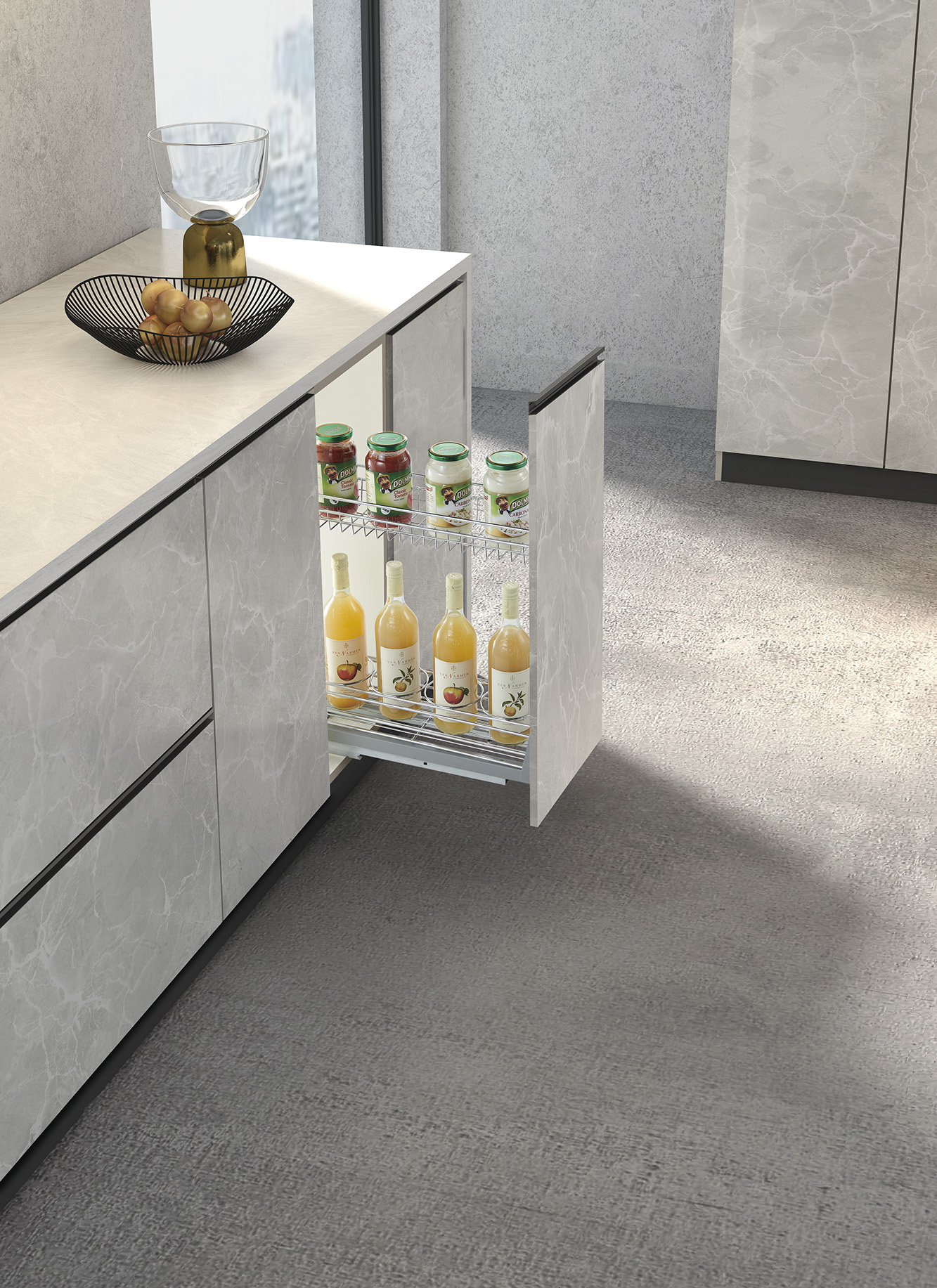
Pull-out baskets are useful when users need access to items stored deep inside a cabinet. Instead of reaching into the back of a fixed shelf, users can bring the stored contents toward the cabinet opening.
Full-extension drawer systems can provide a clearer view of stored items, depending on the drawer design and installation.
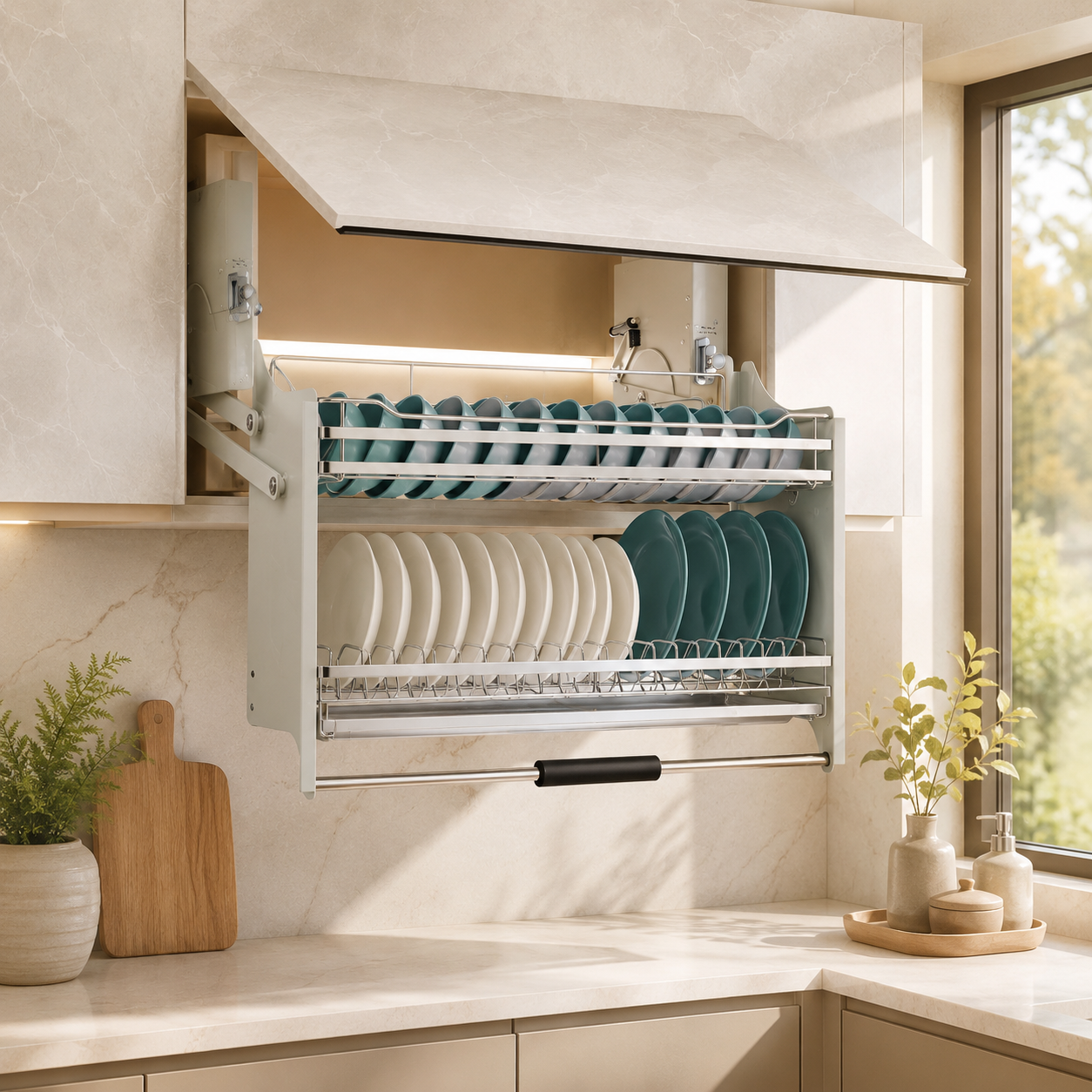
For overhead cabinets, suitable lift-up mechanisms may help improve access while reducing interference from outward-opening doors.
These solutions should be selected according to cabinet dimensions, load requirements, opening clearance, and the intended application.
Not every cabinet needs the same type of hardware. Different mechanisms solve different storage problems.
Pull-out baskets can improve access to items that would otherwise remain difficult to reach at the back of a cabinet. They are particularly useful when the cabinet interior is deep and frequently accessed.
Drawer organizers help separate utensils, kitchen tools, and other small objects. Dividing a drawer into functional sections can reduce clutter and make frequently used items easier to locate.
Corner cabinets often contain space that is difficult to use efficiently. Depending on the cabinet geometry, suitable corner storage mechanisms can improve access to items that would otherwise be stored out of sight.
Lift-up mechanisms can provide an alternative to conventional outward-opening doors in suitable cabinet applications. Their selection should account for door dimensions, door weight, opening angle, and the manufacturer's installation requirements.
The most effective solution is not necessarily the most complicated one. It is the mechanism that addresses a specific storage problem without introducing unnecessary complexity.
Kitchen storage should also account for the people who use it.
Heavy cookware placed in an inconvenient overhead cabinet may require unnecessary lifting. Items stored at the back of a low cabinet may require repeated bending. Frequently used supplies placed too high can make daily tasks uncomfortable.
A thoughtful layout considers the height of storage compartments, the weight of stored items, and the physical effort required to access them.
Deep drawers, accessible pull-out accessories, and appropriately positioned storage zones can help reduce unnecessary bending and reaching.
For multi-generational households, these considerations become even more important because family members may have different heights, strengths, and mobility requirements.
Even a well-planned storage concept can become impractical if the selected hardware does not fit the cabinet.
Before finalizing a kitchen design, verify the internal cabinet dimensions, panel thickness, mounting positions, door clearances, and the space required for moving components.
The rated load capacity should also match the expected application. A mechanism intended for lightweight accessories may not be suitable for heavy cookware or large storage assemblies.
For custom kitchens and large furniture projects, confirming these details during the design stage can help reduce installation problems and unnecessary modifications during production.
Adding more storage does not automatically make a kitchen more functional.
A cabinet packed with too many accessories can become difficult to use. A drawer with excessive compartments may not accommodate larger utensils. A pull-out system that does not match the cabinet dimensions may waste valuable space.
Good storage design balances capacity, accessibility, organization, and ease of maintenance.
It should also consider how users clean the cabinet, remove stored items, and maintain the hardware over time.
For furniture manufacturers, the objective is to create a storage system that works reliably in everyday use, rather than simply maximizing the number of accessories installed.
The most useful kitchen storage solutions begin with practical questions.
Where do users prepare food? Which items do they use most frequently? What needs to be stored close to the sink or cooktop? Which cabinets are difficult to access? How much clearance is available for moving mechanisms?
Answering these questions before selecting hardware helps designers make decisions based on real requirements rather than appearance alone.
For cabinet manufacturers and kitchen hardware suppliers, this approach also creates opportunities to develop more application-specific solutions for different cabinet layouts and customer needs.
Functional kitchen storage is about more than cabinet dimensions or the number of accessories installed. It is about creating a relationship between the kitchen layout, the user's movements, and the hardware that makes each storage area accessible.
By planning around daily activities, selecting suitable mechanisms, and checking installation requirements early, designers can create kitchens that are easier to organize and more comfortable to use.
At WELLDO, we believe practical storage design begins with understanding how people use their space. The right cabinet hardware should support that experience by making storage more accessible, organized, and functional.